



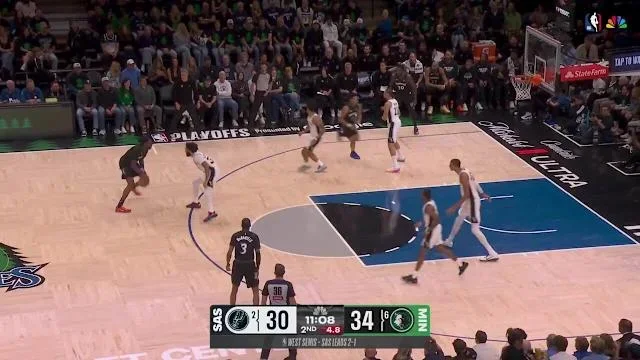

As Victor Wembanyama sat calmly on the San Antonio bench, waiting for the officials—who had taken on the role of jurors—to deliberate on the consequences of a hard elbow that struck Minnesota Timberwolves forward Naz Reid in the throat, a sense of innocence briefly swept over the French star.
Moments earlier, the 22-year-old had joined the team huddle as usual during a timeout, clapped his hands after head coach Mitch Johnson’s instructions, then stood up ready to re-enter the game. Even when the final whistle echoed through the charged atmosphere of the Target Center, handing Wembanyama the first Flagrant 2 foul and ejection of his career, he motioned to Harrison Barnes to quickly relay the message.
What had just happened? The playoffs are praised for heightened aggression and urgency, but on Sunday evening, Wembanyama crossed a line. His momentary lapse in judgment might have been the snowball effect of constant physical play wearing on his broad shoulders—he had scored only four points on 2-for-5 shooting at the time of the incident. However, in a series full of runs and momentum shifts, Wembanyama’s actions cost his team a chance to take a commanding 3-1 series lead.
“I just think the amount of physicality people play with him, at some level you have to protect yourself,” Johnson said after San Antonio’s 114-109 loss that evened the Western Conference semifinals at 2-2. “Every single play on every part of the floor, people try to impose their physicality on him. We don’t complain because we just play and don’t really care. But at some stage, he should be protected, and if not, he’ll have to protect himself—and unfortunately stuff like that happens.”
That’s the duality of spring basketball: the postseason gives and takes. Less than 48 hours earlier, Wembanyama had delivered one of the greatest performances in NBA history—39 points, 15 rebounds, and five blocks on the road, shooting 13-for-18. The contrast between a monstrous historic effort and a costly mistake in the biggest game of this San Antonio core’s life is jarring, even for a first-time offender. But Wembanyama’s absence reinforced several series principles while also shedding light on how the rest of the series might unfold.
The fact that San Antonio remained within striking distance in the fourth quarter—even holding a lead with less than six minutes left—speaks to Johnson and his staff’s ability to handle the Wemby-less scenario. They had already navigated this during the regular season and opened the floodgates in the playoffs, outscoring opponents by 27 points over nearly 350 possessions. Yet, Minnesota’s relentless attack on the paint was a clear byproduct of Wembanyama’s absence. The Wolves scored 14 points in the paint in the final 12 minutes and finished with 50 in total—a significant jump from Games 2 and 3, where they had 36 and 38 respectively. Without Wembanyama, Minnesota’s 39% rim rate—the 80th percentile of playoff games so far—was 10% higher than their series average, higher than their rate against Denver, and above their season-long output. The Wolves also dominated the boards, with Rudy Gobert’s 13 rebounds more than double any Spurs starter, another sign of the lack of fear.
“It’s largely the same,” Wolves coach Chris Finch said of their approach after Wembanyama’s ejection. “Keep trying to go downhill, keep trying to make the defense react and make the right play. Not a lot changed. Naz Reid did a really good job screening—I thought he was outstanding.”
